
According to a paper submitted to the Public Health Report, influenza pandemics have been occurring for at least the past 500 years. A number of influenza pandemics have plagued the planet over the past century, most notably the Spanish flu (1918 pandemic), which saw the H1N1 strain as the culprit of roughly 50 million deaths. Today, influenza virus, with its numerous strains, still circulates the globe. I suspect its prevalence and ability to readily cause epidemics and pandemics, in part, is due to population density. Since the onset of towns and cities and the accompanying close quarters habitation, diseases, whether by bacteria or viruses or parasitic insects, have been transmitted more readily and easily.
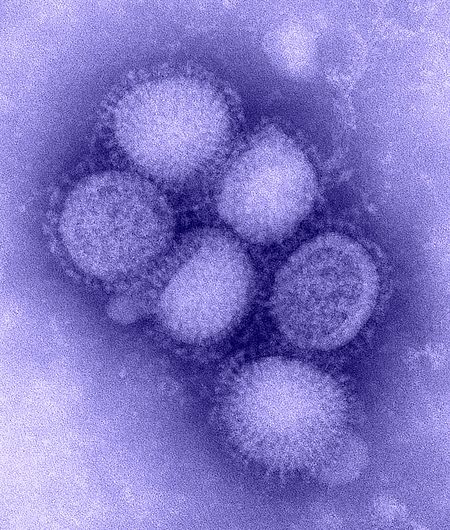
Influenza is generally transmitted through the air and proceeds to infect the upper respiratory tract. Two virulence factors contribute to the virus’s annual ability to evade vaccines. Their envelope contains two proteins, each of which has different variations. The CDC states that different combinations of the surface proteins make it nearly impossible to concoct a single, effective vaccine; furthermore, as it is a RNA virus, gene replication is prone to mutations which effects the structural make-up of the proteins and the human’s immune response to neutralize it. Humans aren’t the only reservoir either, influenza A also infects other animals. It is these strains of the virus which pose potential pandemic outbreaks. They don’t normally infect humans because they don’t have the correct proteins to attach to our cells; however, genetic alterations in their genome may produce new surface proteins that can. After what is called antigenic drift, a mutation in the genome, the virus can infect individuals who are vaccinated, though the virus remains similar to the original and the body’s immune response (post-vaccination) still has some efficacy in fighting it. This is the cause of the seasonal influenza virus, those that typically reside in humans. When antigenic shift occurs, two different strains of influenza exchange RNA molecules. In this way, a virus that previously infected swine, may obtain RNA molecules that encode proteins allowing it to infect humans. It is these novel viruses that often cause pandemics.
Each year, different strains of influenza may be more prevalent than others. Experts in the field monitor influenza circulation throughout the globe to better predict which strains will make an appearance. Dr. John Ross describes how these predictions are made for the northern hemisphere. In Australia, the “flu season” occurs during our summer. By observing which strains affect this great island continent, experts can surmise that these variations will make their way northward for our “flu season”, from autumn to late winter. I guess Australia’s out of luck… To be clear, they are tracking variations of the “seasonal flu” virus and not novel viruses. “Seasonal flu” vaccines, though provide partial protection from antigenic drift varieties, are unlikely to provide a super charged immune response against novel viruses. Instead, the United States government has created a stash of vaccines (“pre-pandemic vaccines”) for potential novel viruses. They are probably tracking these viruses in their respective warm-blooded hosts and conjuring up vaccines in case they undergo an antigenic shift event. If, however, a novel virus, one without a “pre-pandemic vaccine”, makes the jump to a human host, it will take some time to develop an effective vaccine. Six months were needed to deliver the H1N1 vaccine during the 2009 pandemic, and a little over another month to produce large quantities. In case of another pandemic, while you’re waiting for a vaccine to be created, the best way to avoid giving birth to a virus, like with human babies, is to practice abstinence! Don’t touch anyone or speak with anyone and certainly don’t wipe the snot from your human baby’s or grandma’s face! That, or just wear a mask and wash your hands frequently and don gloves… I’ll take my chances with the latex.

 BillyBiome